
The Science Behind Stable IVF Lab Environments Revealed
When people learn that IVF takes place in a laboratory rather than inside the body, a natural question follows: how closely can a lab actually replicate the conditions of the human womb? The answer is: very closely indeed. Modern IVF embryology labs are among the most precisely controlled environments in medicine. Understanding what goes into that control helps explain why seasonal or weather-related concerns about IVF have no scientific basis — and why you can trust the process regardless of when your cycle begins.
Why the Lab Environment Matters So Much
An embryo in its earliest days is extraordinarily sensitive. During the first few days after fertilisation, major biological processes unfold — cell division, genetic programming, and metabolic activity — all of which depend on the surrounding conditions being stable and appropriate. Even small deviations can have lasting consequences.
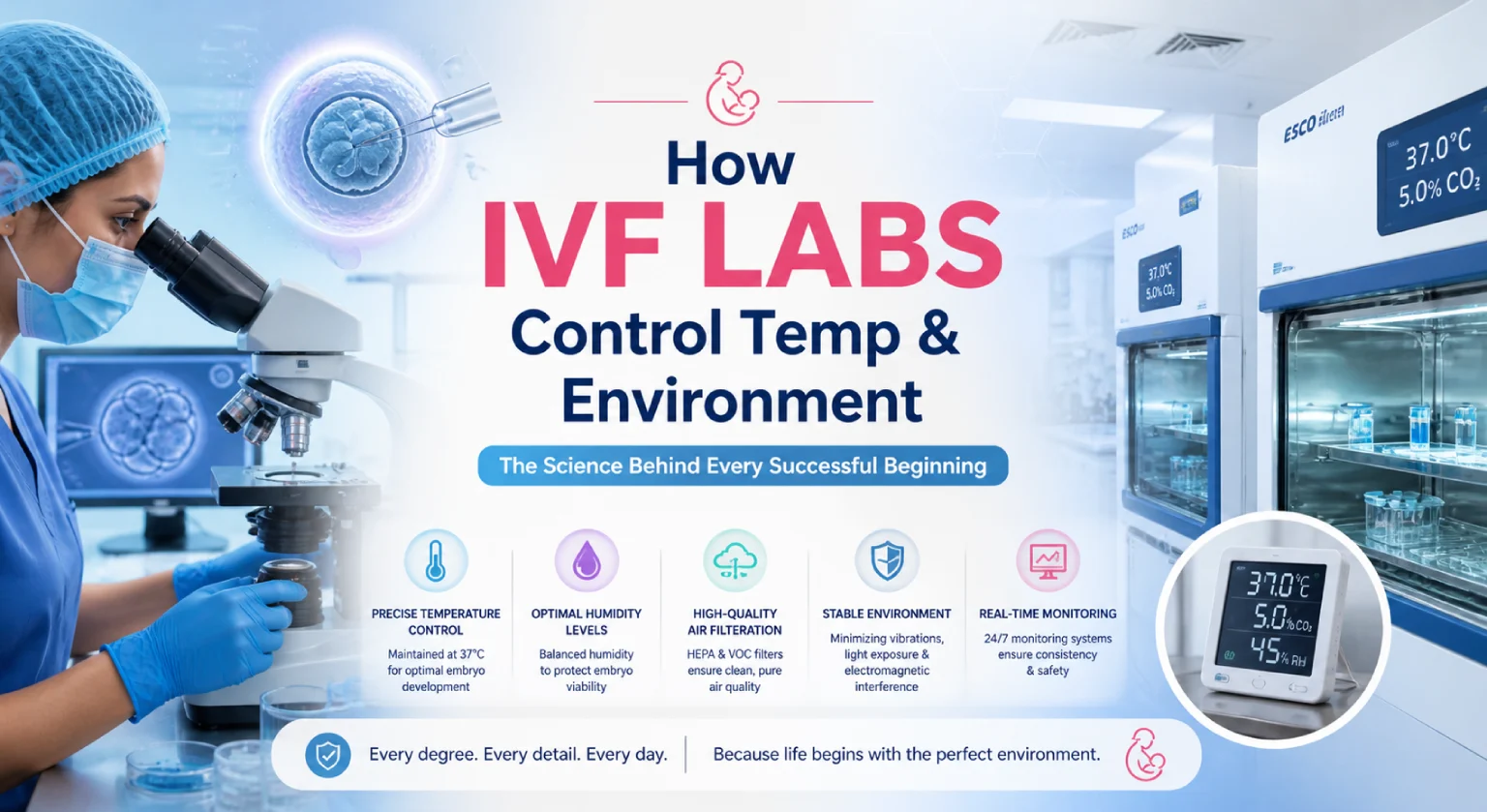
Temperature is the most critical variable. IVF laboratories maintain embryo culture at 37°C, mirroring normal human body temperature, because this is optimal for embryo development. Abnormal temperatures — whether too high or too low — can increase embryonic fragmentation, delay cell division, and in some cases cause chromosomal irregularities that compromise pregnancy outcomes. Every piece of equipment that comes into contact with eggs, sperm, or embryos — incubators, heated stages, culture dishes, and even the culture media itself — must be maintained at this precise temperature at all times.
Key Environmental Controls in a Modern IVF Lab
Temperature Regulation
Every IVF laboratory uses specialist incubators that hold a constant 37°C. When embryologists work outside these incubators — handling eggs during retrieval, performing fertilisation, or assessing embryo quality — they use heated stages designed specifically for IVF to prevent any temperature drop. Even a brief dip in temperature can be harmful, which is why validated, purpose-built equipment is essential. The culture media in which embryos develop is also stored and pre-warmed to precise specifications, since deviations in storage temperature can affect its chemical composition and performance.
Air Quality and HEPA Filtration
The air inside an IVF laboratory is carefully filtered to remove contaminants. High-Efficiency Particulate Air (HEPA) filtration systems remove dust, particles, and airborne pathogens. Many modern labs also use activated carbon filtration to eliminate volatile organic compounds (VOCs) — chemicals found in building materials, cleaning products, and even human breath — which are known to be toxic to developing embryos at surprisingly low concentrations. Air changes per hour, pressure differentials between rooms, and particle counts are all monitored continuously.
CO₂ and pH Control
Embryos need a specific chemical environment to thrive. The culture media has a target pH of around 7.2–7.4, and CO₂ levels inside the incubator are tightly regulated — typically between 5% and 7% — to maintain that pH. Some labs also control oxygen tension, using low-oxygen incubators (around 5% O₂, compared to the 20% found in room air) to more closely replicate the naturally low-oxygen environment of the fallopian tube, where fertilisation normally takes place.
Humidity
Humidity control prevents evaporation from culture dishes, which would alter the concentration of the culture media and stress the embryos. Incubators are humidified to prevent fluid loss during the days an embryo spends developing before transfer.
Real-Time Monitoring
Leading IVF laboratories use continuous electronic monitoring systems that track temperature, CO₂, O₂, and humidity around the clock. Alarms are set to trigger at the slightest deviation, and backup systems are in place so that a power cut or equipment failure does not put embryos at risk.
What This Means for Your IVF Journey
Because the embryo’s entire developmental environment is created and maintained artificially — inside equipment that is independent of the outside world — external factors like the season, weather, or outdoor temperature have no bearing whatsoever on what happens inside the lab. Whether it is 42°C outside in a Pune summer or a cool December morning, the incubator your embryo develops in remains at exactly 37°C.
This is the reason fertility specialists consistently say there is no best season for IVF. The lab is built to eliminate seasonal variability as a factor.
The Role of Laboratory Quality in IVF Success
While the environment is controlled, the quality of that control matters. Not all labs are equal. Factors like incubator type, air filtration standards, embryologist expertise, and equipment calibration practices all contribute to outcomes. When choosing an IVF centre, it is worth asking about their laboratory accreditation, quality management protocols, and whether they use time-lapse incubation systems that allow continuous monitoring of embryo development without removing embryos from the incubator.
At Nucleus IVF, our laboratory is equipped with state-of-the-art incubation and air filtration systems, with real-time environmental monitoring to ensure the safest possible conditions for every embryo in our care.
Dr. Pritam Prakash Sulakhe

Dr. Pritam Prakash Sulakhe
author
Dr. Pritam Prakash Sulakhe has completed his MBBS from B J Government Medical College , Pune which is one of the top medical College in India. He continued his post-graduation as DGO at same institute. After that he opted for Diplomat Of national Board In Obstetrics and Gynecology from Kerala Institute Of Medical Sciences Trivandrum, which is one of the most prestigious institute from South India.
