
What Happens If AMH Is Low?
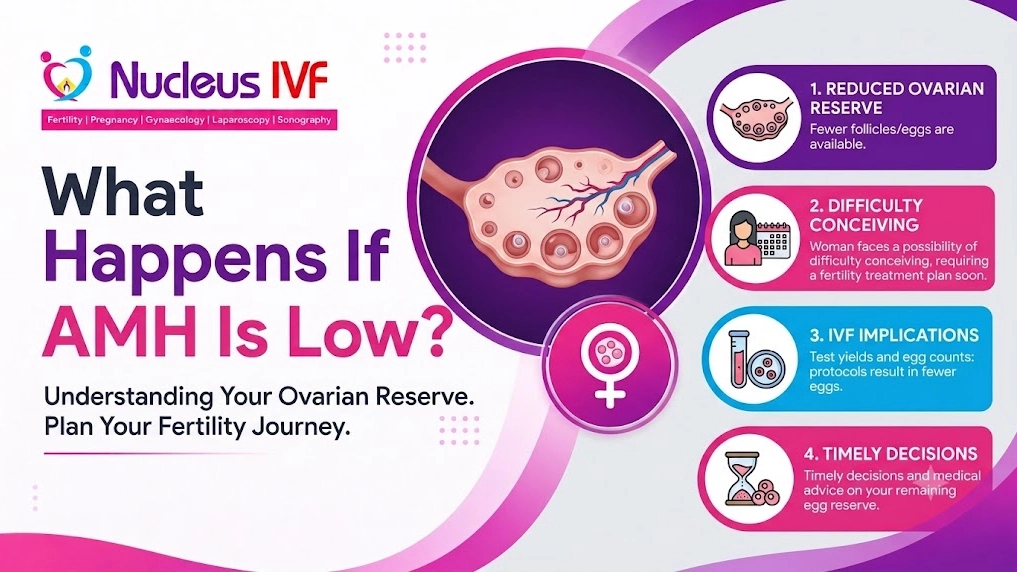
Many women become worried when they receive a report showing low AMH (Anti-Müllerian Hormone) levels. While a low AMH result can indicate a reduced ovarian reserve, it does not necessarily mean you cannot become pregnant. With the right diagnosis, timely treatment, and expert fertility guidance, many women with low AMH have successfully conceived.
Dr. Pritam Prakash Sulakhe, Best IVF Doctor in Pune at Nucleus IVF Centre, explains that AMH is only one part of the fertility assessment. Factors such as age, egg quality, overall reproductive health, and your partner’s fertility are equally important. If your AMH level is low or you’ve been trying to conceive without success, visit Nucleus IVF Centre, Pune, for a comprehensive fertility evaluation and a personalized treatment plan. Early consultation can make a significant difference in your fertility journey.
What Is AMH?
Anti-Müllerian Hormone (AMH) is a hormone produced by the small follicles in a woman’s ovaries. It helps estimate ovarian reserve, which refers to the number of eggs remaining in the ovaries.
Unlike many reproductive hormones, AMH levels remain relatively stable throughout the menstrual cycle, making it a useful marker during fertility evaluation.
What Does Low AMH Mean?
Low AMH indicates that the number of remaining eggs is lower than expected for your age. However, it does not measure egg quality or confirm infertility.
Many women with low AMH still ovulate naturally and achieve pregnancy, especially if they seek timely medical advice.
Common Causes of Low AMH
Several factors can contribute to low AMH levels:
1. Increasing Age
As women age, the ovarian reserve naturally declines. AMH levels usually decrease after the age of 30 and more rapidly after 35.
2. Premature Ovarian Insufficiency (POI)
Some women experience reduced ovarian function before the age of 40, resulting in low AMH.
3. Previous Ovarian Surgery
Removal of ovarian cysts or surgery involving the ovaries may reduce ovarian reserve.
4. Chemotherapy or Radiation
Cancer treatments can affect ovarian function and lower AMH levels.
5. Genetic Factors
Certain inherited conditions may contribute to a lower ovarian reserve.
6. Endometriosis
Severe endometriosis and repeated ovarian surgeries may reduce ovarian reserve.
Symptoms of Low AMH
Low AMH itself usually does not cause symptoms. However, some women may experience:
- 1.Difficulty conceiving
- 2. Irregular menstrual cycles
- 3. Shorter menstrual cycles
- 4. Reduced response during fertility treatment
- 5. Early menopause in some cases
Many women discover they have low AMH only after fertility testing.
Can You Get Pregnant with Low AMH?
Yes.
Low AMH does not mean pregnancy is impossible.
Pregnancy depends on several factors, including:
1. Age
2. Egg Quality
3. Ovulation
4. Fallopian Tube Health
5. Sperm Quality
6. Overall Reproductive Health
A younger woman with low AMH may still have healthy eggs and good chances of natural conception or success with fertility treatment.
How Is Low AMH Diagnosed?
A fertility specialist may recommend:
AMH Blood Test
Measures ovarian reserve.
Ultrasound Scan
An antral follicle count (AFC) helps estimate the number of developing follicles.
Additional Hormone Tests
These may include:
- 1. FSH (Follicle-Stimulating Hormone)
2. LH (Luteinizing Hormone)
3. Estradiol (E2)
4. Thyroid Profile (TSH, T3, T4)
5. Prolactin
A complete fertility evaluation often includes assessment of the male partner as well.
Treatment Options for Low AMH
Treatment depends on your age, fertility goals, and overall reproductive health.
Lifestyle Improvements
Healthy habits can support reproductive health:
1. Eat a Balanced Diet
2. Exercise Regularly
3. Maintain a Healthy Weight
4. Avoid Smoking and Excessive Alcohol
5. Sleep Well
6. Manage Stress
Ovulation Monitoring
For women who continue to ovulate, monitoring fertile days and timed intercourse may be advised.
Fertility Medications
Your doctor may prescribe medications to stimulate ovulation when appropriate.
IVF Treatment
Women with low AMH may benefit from IVF, particularly when ovarian reserve is significantly reduced or age is a factor. Treatment plans are individualized based on ovarian response and other clinical findings.
Egg Freezing
Women who are not yet ready for pregnancy but have low AMH may discuss fertility preservation options with their doctor.
Foods That May Support Fertility
While no food can increase AMH levels, a nutritious diet supports overall reproductive health.
Include:
- 1. Green Leafy Vegetables
2. Fresh Fruits
3. Nuts and Seeds
4. Whole Grains
5. Lean Proteins
6. Eggs
7. Fish Rich in Omega-3 Fatty Acids
8. Dairy Products (If Appropriate)
Stay hydrated and limit processed foods, sugary drinks, and smoking.
When Should You See a Fertility Specialist?
Schedule a fertility consultation if:
- 1. You Have Been Trying to Conceive for More Than 12 Months (or 6 Months if You Are 35 or Older)
2. Your AMH Test Shows a Low Value
3. You Have Irregular Periods
4. You Have a History of Ovarian Surgery or Endometriosis
5. You Have Experienced Recurrent Pregnancy Loss
6. You Are Planning to Delay Pregnancy and Want to Understand Your Fertility Status
Early evaluation can help identify the most appropriate treatment options.
Myths About Low AMH
Myth 1: Low AMH Means You Can Never Become Pregnant
False. Many women with low AMH conceive naturally or with fertility treatment.
Myth 2: AMH Measures Egg Quality
False. AMH estimates egg quantity, not quality.
Myth 3: AMH Alone Determines IVF Success
False. Age, embryo quality, sperm health, uterine health, and other factors all influence treatment outcomes.
Tips for Women with Low AMH
- 1. Don’t Delay Fertility Evaluation
2. Maintain a Healthy Lifestyle
3. Follow Your Fertility Specialist’s Advice
4. Avoid Smoking and Excessive Alcohol
5. Complete Recommended Fertility Investigations
6. Discuss All Available Treatment Options Early
Conclusion
A low AMH level can feel overwhelming, but it is not the end of your fertility journey. It simply indicates that your ovarian reserve is lower than expected. Many women with low AMH achieve healthy pregnancies with timely medical care, appropriate fertility treatments, and individualized planning.
If your AMH report shows low levels or you’ve been trying to conceive without success, don’t wait. Visit Nucleus IVF Centre, Pune, and consult Dr. Pritam Prakash Sulakhe for a complete fertility assessment. Our experienced fertility specialists will help identify the underlying cause and recommend the most suitable treatment to improve your chances of parenthood.
Dr. Pritam Prakash Sulakhe

Dr. Pritam Prakash Sulakhe
author
Dr. Pritam Prakash Sulakhe has completed his MBBS from B J Government Medical College , Pune which is one of the top medical College in India. He continued his post-graduation as DGO at same institute. After that he opted for Diplomat Of national Board In Obstetrics and Gynecology from Kerala Institute Of Medical Sciences Trivandrum, which is one of the most prestigious institute from South India.
