After months of trying to conceive, a couple may begin asking difficult questions. “Why hasn’t pregnancy happened yet?” Sometimes the answer is related to the fallopian tubes or sperm. Sometimes routine tests appear normal, yet conception remains difficult. And sometimes, fertility testing reveals that the ovaries are not functioning as expected.
This can be especially surprising for women who are younger than 40 and never expected to hear the words premature ovarian insufficiency (POI).
At Nucleus IVF Centre, Pune, Dr. Pritam Prakash Sulakhe helps couples understand the reasons behind difficulty conceiving and explore fertility options based on their individual circumstances. If you have been trying to conceive without success or have been diagnosed with diminished ovarian reserve, visit Nucleus IVF Centre for a personalized fertility evaluation.
What Is Premature Ovarian Insufficiency?
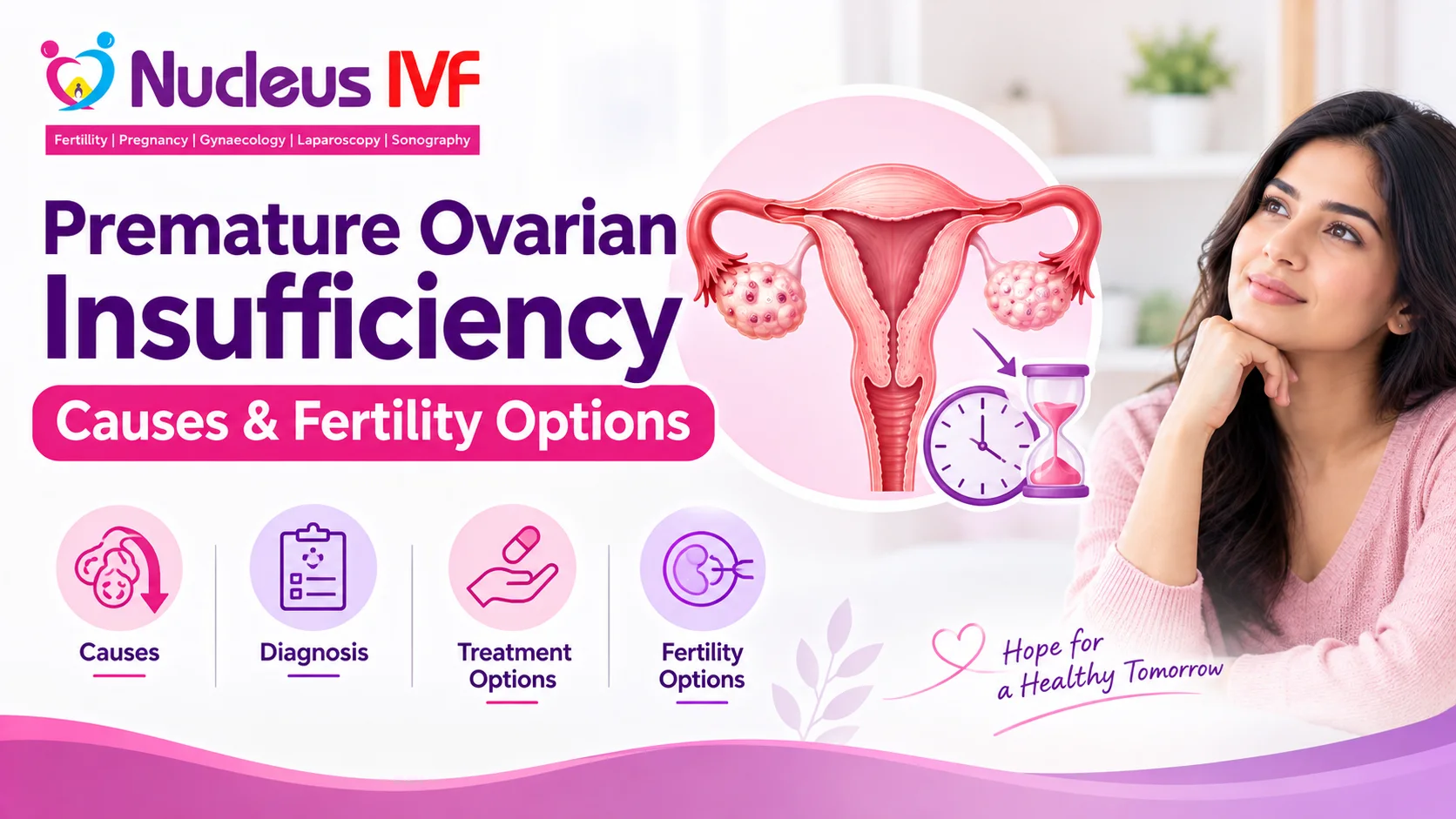
Premature ovarian insufficiency (POI) occurs when the ovaries lose normal function before the age of 40.
The ovaries may produce eggs less consistently and may produce lower levels of estrogen. Menstrual periods can become irregular or stop altogether.
POI is different from natural menopause. Ovarian activity in POI can sometimes be intermittent, meaning some women may occasionally ovulate despite the diagnosis. Because of this, spontaneous pregnancy can still occur in a small proportion of women.
A Story Many Couples Don’t Expect
Imagine a couple who have been trying for more than a year. They have tracked ovulation, changed their diet, and waited hopefully every month.
When they finally visit a fertility specialist, the initial tests may reveal something unexpected: the woman’s ovarian reserve is lower than expected for her age.
This can bring fear and uncertainty.
But a fertility diagnosis is not the end of the journey. It is information—and information can help couples understand what options they have.
What Causes POI?
Sometimes, the exact cause cannot be identified. However, possible causes and associated factors include:
Genetic Factors
Certain genetic conditions or chromosome-related abnormalities can affect ovarian function.
Autoimmune Conditions
In some women, the immune system may be associated with damage to ovarian tissue. Doctors may investigate relevant autoimmune conditions when indicated.
Medical Treatments
Certain cancer treatments, including chemotherapy and radiation involving the reproductive organs, can affect ovarian function.
Previous Ovarian Surgery
Some ovarian procedures may reduce ovarian tissue or affect ovarian reserve.
Other Causes
In many women, no clear cause is identified. This is known as idiopathic POI.
What Are the Symptoms of POI?
Symptoms can vary, but may include:
- Irregular or missed periods
- Difficulty conceiving
- Hot flashes
- Night sweats
- Vaginal dryness
- Reduced sexual desire
- Sleep difficulties
- Mood changes
Some women discover POI primarily through fertility testing and may have few obvious symptoms.
How Is POI Diagnosed?
Diagnosis requires medical evaluation rather than relying on a single test.
Your fertility specialist may consider:
- Menstrual history
- Symptoms
- Pregnancy history
- Hormone testing
- FSH levels
- Estradiol levels
- AMH and ovarian reserve assessment
- Pelvic ultrasound
- Additional genetic or autoimmune testing when appropriate
Importantly, a low AMH level alone does not mean that a woman has POI. AMH is primarily a marker of ovarian reserve, while POI involves impaired ovarian function and requires appropriate clinical and hormonal assessment.
Can You Get Pregnant With POI?
This is often the first question couples ask after diagnosis.
Pregnancy may still be possible in some women with POI, but fertility can be significantly reduced. Occasional spontaneous ovulation can occur, but it is difficult to predict when it will happen.
The appropriate fertility option depends on factors such as age, ovarian activity, ovarian reserve, previous treatment, and the couple’s preferences.
Fertility Options for POI
1. IVF Using Your Own Eggs
If ovarian activity and follicles are still present, your fertility specialist may discuss whether IVF using your own eggs is appropriate.
However, response to ovarian stimulation can be limited in women with significantly reduced ovarian function.
2. Donor Eggs
For women whose ovaries are no longer producing usable eggs consistently, donor-egg IVF may be an option.
An egg from a donor is fertilized with sperm, and the resulting embryo is transferred into the recipient’s uterus after appropriate preparation.
3. Embryo or Egg Preservation
If diminished ovarian reserve is identified before ovarian function declines further, fertility preservation may be discussed in selected women.
The earlier ovarian reserve concerns are identified, the more options may be available.
4. Counseling and Emotional Support
A diagnosis of POI can bring grief, anxiety, and uncertainty—especially when pregnancy has been a long-awaited goal.
Couples should have the opportunity to discuss both the medical options and the emotional impact of fertility treatment.
When Should You See a Fertility Specialist?
If you have been trying to conceive for 12 months if under 35, or 6 months if 35 or older, a fertility evaluation is generally recommended. Earlier evaluation may be appropriate if you have irregular periods, previous ovarian surgery, endometriosis, chemotherapy or radiation exposure, or known fertility concerns.
Don’t wait for symptoms to become severe before seeking help.
Take the Next Step Toward Parenthood
Hearing that your ovarian reserve is low—or that you may have POI—can feel overwhelming. But understanding your diagnosis gives you an opportunity to discuss realistic fertility options and plan the next step.
At Nucleus IVF Centre, Pune, Dr. Pritam Prakash Sulakhe provides personalized fertility assessment and guidance for couples facing diminished ovarian reserve, unexplained infertility, and other fertility challenges.
If you have been trying to conceive without success or are concerned about your ovarian reserve, visit Nucleus IVF Centre to discuss your fertility options and create a treatment plan suited to your needs.
Dr. Pritam Prakash Sulakhe

Dr. Pritam Prakash Sulakhe
author
Dr. Pritam Prakash Sulakhe has completed his MBBS from B J Government Medical College , Pune which is one of the top medical College in India. He continued his post-graduation as DGO at same institute. After that he opted for Diplomat Of national Board In Obstetrics and Gynecology from Kerala Institute Of Medical Sciences Trivandrum, which is one of the most prestigious institute from South India.
