
What Is the Difference Between IVF, ICSI, and Advanced IVF Technologies?
IVF, ICSI, and advanced IVF technologies differ in fertilization methods and precision. ICSI is used for male infertility, while advanced techniques like AI and PGT improve embryo selection and success rates.
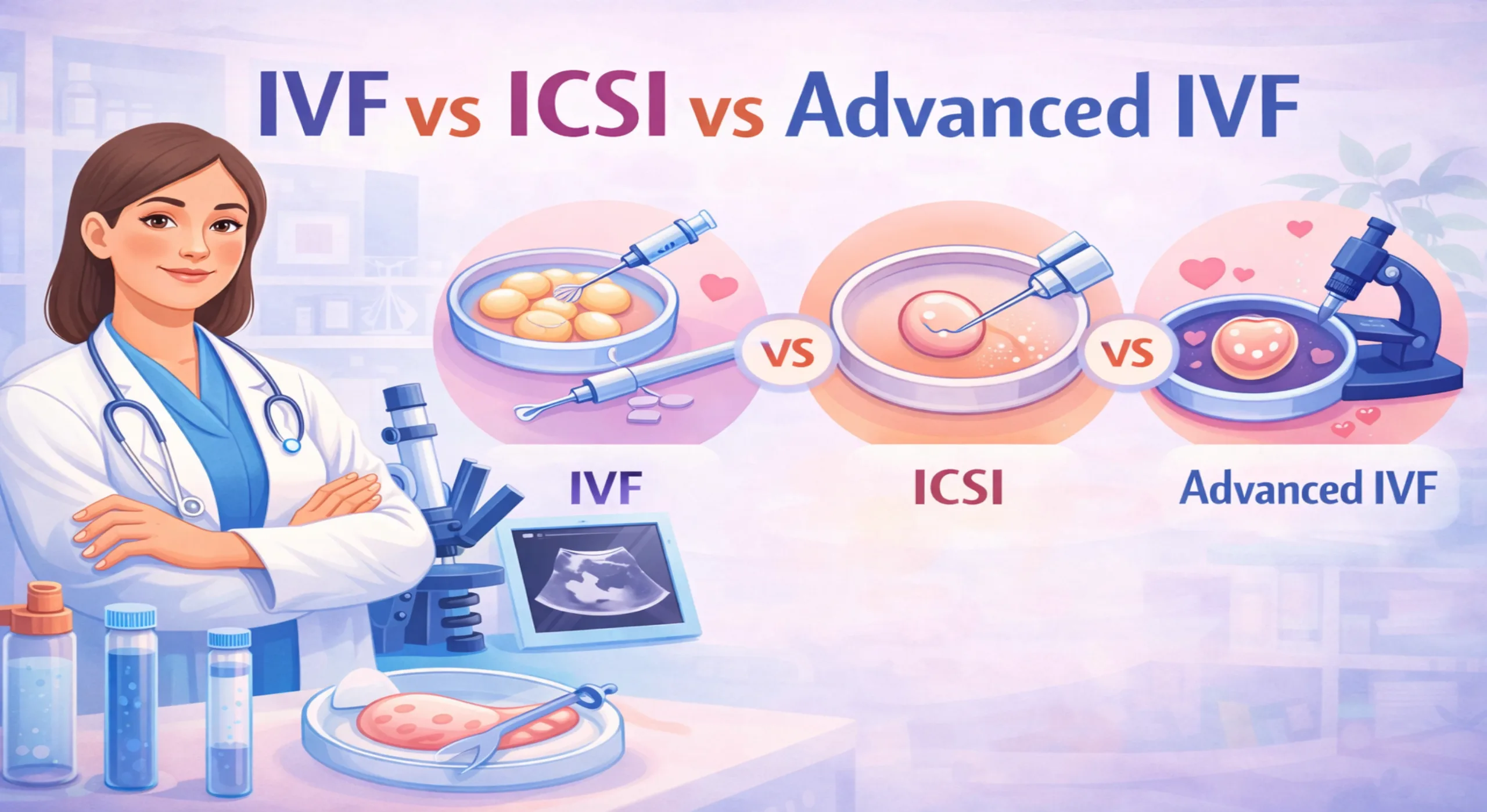
Choosing the right fertility treatment can feel overwhelming, especially when you come across terms like IVF, ICSI, and advanced IVF technologies. While all these treatments aim to help couples achieve pregnancy, they differ significantly in their approach, technology, and suitability.
Understanding these differences is crucial to making an informed decision that aligns with your specific fertility condition.
🔸 What is IVF (In Vitro Fertilization)?
IVF is one of the most common and widely used fertility treatments. In this process, eggs and sperm are combined in a laboratory dish, allowing fertilization to occur naturally.
✔ How IVF Works:
- Ovaries are stimulated to produce multiple eggs
- Eggs are retrieved from the ovaries
- Sperm is collected and processed
- Eggs and sperm are mixed in a lab
- Fertilized embryos are transferred into the uterus
✔ Best Suited For:
- Blocked fallopian tubes
- Ovulation disorders
- Unexplained infertility
✔ Advantages:
- Less invasive compared to ICSI
- Mimics natural fertilization process
- Effective for many infertility cases
However, IVF may not be ideal in cases where sperm quality is significantly low.
🔸 What is ICSI (Intracytoplasmic Sperm Injection)?
ICSI is a specialized form of IVF where a single healthy sperm is directly injected into an egg to achieve fertilization.
✔ How ICSI Works:
- Egg retrieval process is same as IVF
- A single sperm is selected under a microscope
- The sperm is injected directly into the egg
- Resulting embryo is transferred to the uterus
✔ Best Suited For:
- Male infertility (low sperm count or poor motility)
- Previous IVF failure
- Poor fertilization rates
✔ Advantages:
- Higher chances of fertilization in difficult cases
- Overcomes sperm-related issues
- Requires fewer sperm
ICSI has revolutionized fertility treatment, especially for couples dealing with male factor infertility.
🔸 What Are Advanced IVF Technologies?
With rapid advancements in reproductive medicine, modern IVF has evolved beyond traditional methods. Advanced technologies aim to improve precision, embryo selection, and overall success rates.
✔ Common Advanced IVF Techniques:
1. Genetic Testing (PGT)
Preimplantation Genetic Testing helps identify genetic abnormalities in embryos before transfer, reducing the risk of inherited conditions.
2. AI-Based Embryo Selection
Artificial intelligence is used to analyze embryo development and select the most viable one for transfer.
3. Blastocyst Culture
Embryos are grown for 5–6 days to select stronger embryos with higher implantation potential.
4. Time-Lapse Imaging
Continuous monitoring of embryo development without disturbing lab conditions.
🔸 Key Differences: IVF vs ICSI vs Advanced IVF
| Feature | IVF | ICSI | Advanced IVF |
|---|---|---|---|
| Fertilization | Natural in lab | Sperm injected into egg | Enhanced selection methods |
| Best For | General infertility | Male infertility | Complex/repeated failures |
| Technology Level | Standard | Moderate | High |
| Precision | Moderate | High | Very High |
🔸 Which Treatment Should You Choose?
There is no “one-size-fits-all” answer. The best treatment depends on multiple factors:
✔ 1. Cause of Infertility
- If sperm quality is normal → IVF may be sufficient
- If male infertility is present → ICSI is preferred
✔ 2. Age of the Woman
Women above 35 may benefit from advanced technologies like genetic testing.
✔ 3. Previous IVF Failures
Repeated failures may require advanced IVF techniques for better outcomes.
✔ 4. Embryo Quality Concerns
Advanced tools help select the healthiest embryos.
🔸 Expert Insight
Fertility specialists often recommend a personalized approach rather than a fixed treatment plan. In many cases, IVF may be combined with ICSI or advanced technologies to improve success rates.
The goal is not just fertilization — but achieving a healthy, successful pregnancy.
🔸 Common Myths About IVF & ICSI
❌ Myth 1: ICSI is always better than IVF
✔ Truth: ICSI is only beneficial in specific cases like male infertility.
❌ Myth 2: Advanced IVF guarantees success
✔ Truth: It improves chances but does not guarantee pregnancy.
❌ Myth 3: All patients need advanced IVF
✔ Truth: Many couples conceive successfully with basic IVF.
🔸 Final Thoughts
IVF, ICSI, and advanced IVF technologies are all powerful tools in modern fertility treatment. The right choice depends on your unique medical condition, fertility history, and treatment goals.
- IVF is ideal for general infertility cases
- ICSI is best for male factor infertility
- Advanced IVF technologies are recommended for complex or repeated failures
Consulting an experienced fertility specialist is the most important step in choosing the right path.
Dr. Pritam Prakash Sulakhe

Dr. Pritam Prakash Sulakhe
author
Dr. Pritam Prakash Sulakhe has completed his MBBS from B J Government Medical College , Pune which is one of the top medical College in India. He continued his post-graduation as DGO at same institute. After that he opted for Diplomat Of national Board In Obstetrics and Gynecology from Kerala Institute Of Medical Sciences Trivandrum, which is one of the most prestigious institute from South India.