Starting IVF can feel overwhelming when you don’t know what happens at each stage. Understanding the IVF process can help you prepare physically and emotionally and make informed decisions with your fertility specialist. At Nucleus IVF Centre, Pune, Dr. Pritam Prakash Sulakhe helps couples understand their fertility options and develop a treatment plan based on their individual needs. If you have been trying to conceive without success, visit Nucleus IVF Centre for a personalized fertility consultation.
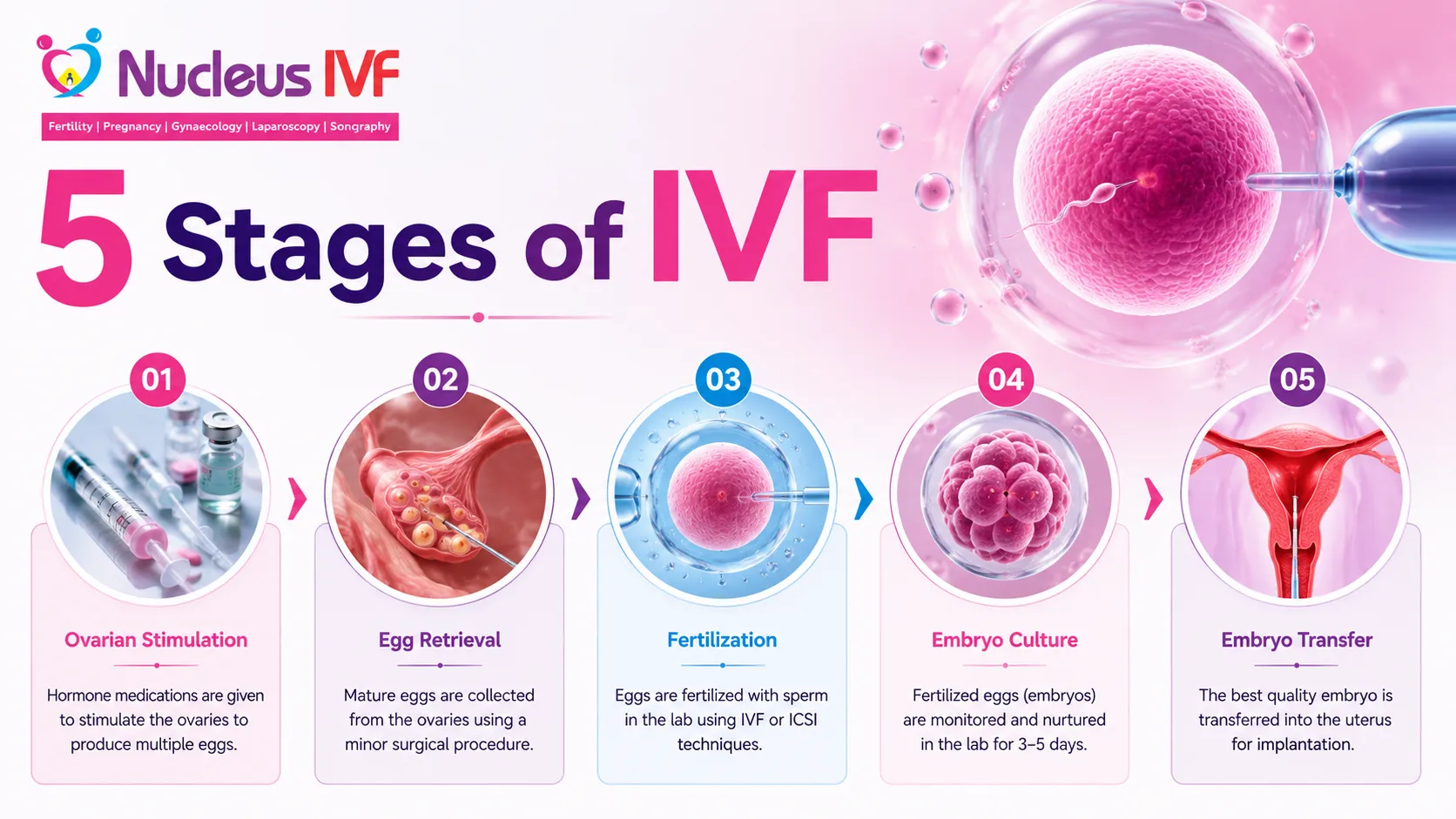
IVF, or in vitro fertilization, involves stimulating the ovaries, retrieving eggs, fertilizing them with sperm in a laboratory, developing embryos, and transferring a suitable embryo into the uterus. The exact protocol can vary depending on age, ovarian reserve, fertility history, sperm parameters, and previous treatment.
What Are the 5 Stages of IVF?
The IVF journey can be broadly understood in five major stages:
- Ovarian stimulation and monitoring
- Egg retrieval and sperm collection
- Fertilization and embryo development
- Embryo selection and preparation
- Embryo transfer and pregnancy testing
Let’s understand each stage in detail.
Stage 1: Ovarian Stimulation and Monitoring
The first stage of IVF focuses on encouraging the ovaries to develop multiple follicles containing eggs.
In a natural menstrual cycle, usually one dominant follicle develops. During IVF, fertility medicines are used to stimulate the ovaries so that multiple eggs may mature during the same cycle. The medication protocol is customized according to your fertility profile.
What happens during ovarian stimulation?
Your fertility specialist may recommend:
- Hormonal injections to stimulate the ovaries
- Medicines to prevent premature ovulation
- Regular ultrasound monitoring
- Blood tests when required
- A final “trigger” injection when the follicles are ready
Monitoring is important because your doctor needs to assess follicle growth and determine the appropriate timing for egg retrieval.
The duration of stimulation varies from person to person. Therefore, you should follow the medication schedule provided by your fertility specialist rather than comparing your treatment timeline with someone else’s.
Why is monitoring important?
The goal isn’t simply to produce a large number of eggs. Your fertility team aims to achieve an appropriate response while maintaining your safety and maximizing the possibility of obtaining mature eggs.
Stage 2: Egg Retrieval and Sperm Collection
Once the follicles have reached an appropriate stage of development, your doctor schedules egg retrieval.
A trigger injection is generally given at a carefully calculated time before egg collection. Timing is important because the eggs need to be at the appropriate stage of maturity when they are retrieved.
How are eggs retrieved?
Egg retrieval, also called oocyte retrieval, is performed using ultrasound guidance. A fine needle is passed through the vaginal wall to reach the ovarian follicles and collect the follicular fluid containing the eggs.
The procedure generally takes around 20 minutes, although the exact duration can vary. Sedation or anesthesia may be used depending on the clinic and individual circumstances.
At approximately the same time, a sperm sample is collected. If donor or previously frozen sperm is being used, the laboratory prepares the sample for treatment.
Important to remember
Not every follicle necessarily contains an egg, and the number of eggs retrieved can be different from the number of follicles seen on ultrasound. Your fertility specialist will explain your individual results after the procedure.
Stage 3: Fertilization and Embryo Development
After egg retrieval, the eggs and sperm are taken to the IVF laboratory.
There are two common approaches to fertilization:
Conventional IVF
The prepared sperm and eggs are placed together in a laboratory dish to allow fertilization to occur.
ICSI
With Intracytoplasmic Sperm Injection (ICSI), an embryologist injects a single sperm directly into an egg. ICSI may be recommended in certain situations, including some cases involving low sperm count or poor sperm movement.
After fertilization, the developing embryos are carefully monitored in the laboratory.
Embryos continue to divide and develop over the following days. Some may reach the blastocyst stage around day 5, although development can vary.
Does every egg become an embryo?
No.
This is one of the most important things couples should understand about IVF.
The number of eggs retrieved does not equal the number of embryos available for transfer. Some eggs may not be mature, some may not fertilize, and some embryos may stop developing.
Your embryology team monitors embryo development and provides updates during this stage.
Stage 4: Embryo Selection and Preparation
Once embryos have developed, your fertility team determines which embryo or embryos are appropriate for transfer based on the treatment plan and embryo development.
In suitable cases, embryos may be allowed to develop to the blastocyst stage before transfer or freezing. Embryos that are suitable for future use may also be frozen.
Fresh vs Frozen Embryo Transfer
Depending on your medical situation, your doctor may recommend:
Fresh embryo transfer: An embryo is transferred during the same IVF cycle after egg retrieval and embryo development.
Frozen embryo transfer: A suitable embryo that has been frozen is transferred during a later cycle when the uterine lining has been prepared.
A frozen transfer may be recommended when the clinical team believes delaying transfer would be more appropriate or when embryos are being preserved for future treatment.
Your doctor will decide which approach is appropriate based on your individual circumstances.
Stage 5: Embryo Transfer and Pregnancy Test
Embryo transfer is the stage many couples look forward to after the laboratory phase.
During the procedure, the selected embryo is placed into the uterus using a thin catheter passed through the cervix. Embryo transfer is generally simpler than egg retrieval and usually does not require sedation.
What happens after embryo transfer?
You will receive instructions about:
- Medications to continue
- When to take your pregnancy test
- Activities and precautions
- Follow-up appointments
- When an ultrasound may be scheduled
A pregnancy test is performed after an appropriate waiting period. Testing too early can sometimes produce misleading results because medications used during IVF may affect the result. Follow the testing date provided by your fertility clinic.
If the pregnancy test is positive, your fertility team will guide you through the next steps, including an early pregnancy scan.
How Long Does the IVF Process Take?
The timeline varies depending on the treatment protocol and whether a fresh or frozen embryo transfer is planned.
A complete IVF cycle may take several weeks, while some treatment plans require additional preparation before embryo transfer. NHS guidance notes that a full IVF cycle commonly takes around 3 to 6 weeks, although individual timelines vary.
Your fertility specialist can provide a more accurate timeline after reviewing your medical history and test results.
What Factors Can Affect IVF Success?
IVF success is not determined by a single factor. Your chances may be influenced by:
- Age
- Ovarian reserve and egg quality
- Sperm quality
- Embryo quality
- Uterine and endometrial factors
- Underlying fertility conditions
- Previous IVF outcomes
- Overall health and lifestyle
- The specific treatment protocol
This is why comparing your IVF journey with another couple’s experience may not provide an accurate picture of your own chances.
When Should You Consider Consulting an IVF Specialist?
You may benefit from a fertility evaluation if you have been trying to conceive without success, particularly if you have:
- Been trying to conceive for an extended period
- Irregular or absent periods
- Low ovarian reserve or AMH concerns
- Endometriosis
- Blocked or damaged fallopian tubes
- Previous recurrent pregnancy loss
- Male-factor fertility concerns
- Previous unsuccessful fertility treatments
- A history of ovarian or reproductive surgery
An evaluation can help identify possible causes and determine whether IVF or another fertility treatment is appropriate.
Why Personalized IVF Treatment Matters?
There is no single IVF protocol that works identically for every couple.
A fertility specialist considers your age, ovarian reserve, medical history, previous treatments, sperm parameters, and other factors before designing your treatment plan.
At Nucleus IVF Centre in Pune, the goal is to provide couples with individualized fertility care, explain each stage clearly, and help them understand their available treatment options.
If you are considering IVF, getting the right evaluation before starting treatment can help you understand what to expect and make better-informed decisions.
Frequently Asked Questions
1. What are the five main stages of IVF?
The five broad stages are ovarian stimulation and monitoring, egg retrieval and sperm collection, fertilization and embryo development, embryo selection and preparation, and embryo transfer followed by pregnancy testing.
2. Is IVF painful?
Some parts of IVF, particularly injections and egg retrieval, may cause discomfort. Egg retrieval is generally performed with sedation or anesthesia depending on the treatment center and patient. Embryo transfer is usually a simpler procedure and typically does not require sedation.
3. How many eggs are needed for IVF?
There is no universal number of eggs that guarantees success. The number retrieved depends on factors such as age, ovarian reserve and response to stimulation. The quality and development of the resulting embryos are also important.
4. What happens if IVF does not result in pregnancy?
If an IVF cycle does not result in pregnancy, your fertility specialist can review the cycle and discuss what happened at each stage. Depending on the circumstances, the next step could involve another IVF cycle, frozen embryo transfer, additional investigations, or a different treatment strategy.
5. Can IVF guarantee a baby?
No fertility treatment can guarantee a pregnancy or live birth. IVF can provide an important treatment option for many couples, but outcomes vary from person to person.
Take the Next Step Toward Parenthood
Understanding the 5 stages of IVF can make the treatment journey less confusing, but deciding whether IVF is right for you requires a personalized medical assessment.
If you are struggling to conceive or considering IVF treatment in Pune, consult Dr. Pritam Prakash Sulakhe at Nucleus IVF Centre to discuss your fertility evaluation and treatment options.
Don’t keep postponing your fertility consultation if you have been trying to conceive without success. Visit Nucleus IVF Centre, Pune, and take the next step toward understanding your fertility options.
Dr. Pritam Prakash Sulakhe

Dr. Pritam Prakash Sulakhe
author
Dr. Pritam Prakash Sulakhe has completed his MBBS from B J Government Medical College , Pune which is one of the top medical College in India. He continued his post-graduation as DGO at same institute. After that he opted for Diplomat Of national Board In Obstetrics and Gynecology from Kerala Institute Of Medical Sciences Trivandrum, which is one of the most prestigious institute from South India.
