Advancements in reproductive medicine have transformed the way fertility specialists evaluate and select embryos, giving couples a stronger chance at achieving parenthood. At Nucleus IVF, Dr. Pritam Prakash Sulakhe – Best IVF Doctor in Pune – is known for integrating Advance Technologies like AI-driven embryo selection to make the IVF journey more accurate, efficient, and successful.
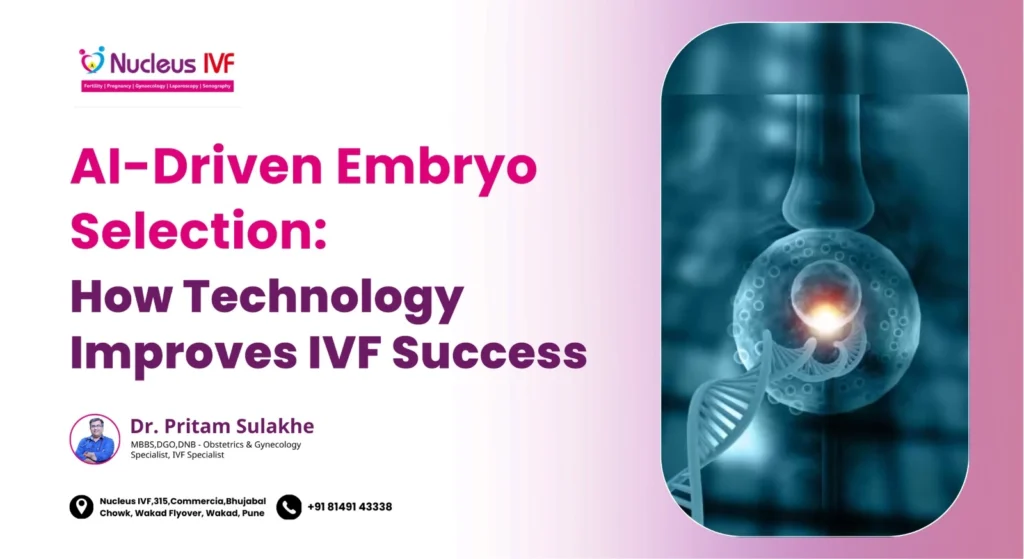
With AI becoming a powerful analytical tool, embryo selection has shifted from subjective evaluation to precise, data-based decision-making.
Artificial Intelligence brings consistency and accuracy to the embryology lab—two factors that significantly impact IVF outcomes. Traditionally, embryo grading depended on visual observation by embryologists, who examined factors like cell division rate, shape, and fragmentation.
While experts are highly skilled, human evaluation can be influenced by subtle variations or limitations in what the eye can detect. AI overcomes these barriers by analyzing embryos at a microscopic level, studying patterns, and predicting implantation potential based on millions of data points.
One of the key advancements in AI-driven embryo selection is the ability to analyze time-lapse images. Many modern incubators are equipped with cameras that capture embryo development every few minutes. This creates a continuous record of cell division, growth patterns, and morphological changes.
AI models study these time-lapse videos to identify micro-level indicators that correlate with higher success rates. Even slight differences in the timing of cell division—sometimes unnoticed by humans—become valuable predictors when processed through AI algorithms.
AI tools also score embryos more objectively. Instead of relying on manual grading systems, AI assigns scores based on standardized criteria, significantly reducing human error or inter-observer variation.
This means that whether a clinic is handling 20 embryos or 200, each embryo undergoes the same unbiased evaluation. For couples, this translates into a more reliable selection process, increasing the chances of choosing the embryo most likely to result in pregnancy.
Another breakthrough is the use of AI to predict chromosomal normalcy. Traditionally, checking an embryo’s chromosomes required Preimplantation Genetic Testing (PGT), which involved removing a few cells from the embryo. While effective, PGT is invasive, expensive, and not always necessary.
AI tools are now being developed to assess the likelihood of chromosomal abnormalities non-invasively, based solely on visual patterns and developmental behavior. As this technology becomes more refined, it may reduce the need for embryo biopsy altogether.
Couples going through IVF often feel overwhelmed by the complexity of the process. AI adds transparency by providing visual reports, scores, and explanations that help patients understand why a particular embryo is being chosen.
This enhances trust and confidence, making the journey emotionally easier. Patients gain clarity on how their embryos were evaluated, rather than relying solely on verbal explanations.
From a clinical perspective, AI enhances workflow efficiency. Embryologists can focus more on culture conditions, quality control, and lab precision, while AI manages the repetitive analysis.
This improves overall lab performance—a critical factor for IVF success. At Nucleus IVF, the combination of expert embryologists and advanced AI tools creates a strong ecosystem where technology amplifies human expertise.
AI also plays a role in improving long-term outcomes. By selecting the healthiest embryo, clinics can reduce the number of IVF cycles needed. This minimizes physical discomfort, emotional stress, and cost for couples. When used alongside other technologies like time-lapse incubation, vitrification, and advanced culture media, AI becomes a cornerstone of modern IVF success.
It is important to clarify that AI does not replace the expertise of embryologists or fertility doctors. Instead, it acts as a sophisticated support system.
Experienced specialists like Dr. Pritam Prakash Sulakhe interpret AI data within the context of each patient’s medical history, reproductive health, and treatment goals. The synergy between human judgment and AI intelligence results in more reliable and personalized care.
As AI continues to evolve, the future of embryo selection looks even more promising. Emerging algorithms are focusing on predicting live birth rates, identifying subtle genetic markers, and integrating patient-specific data such as age, hormonal profiles, and medical conditions. These advancements could make IVF more precise and accessible than ever before.
Conclusion
AI-driven embryo selection is revolutionizing the IVF landscape, offering accuracy, transparency, and improved pregnancy outcomes. By embracing this technology, clinics like Nucleus IVF provide couples with the highest level of care. Under the guidance of experts such as Dr. Pritam Prakash Sulakhe – Best IVF Doctor in Pune – AI becomes more than just a tool; it becomes a transformative force in helping families grow with confidence and hope.
Dr. Pritam Prakash Sulakhe

Dr. Pritam Prakash Sulakhe
author
Dr. Pritam Prakash Sulakhe has completed his MBBS from B J Government Medical College , Pune which is one of the top medical College in India. He continued his post-graduation as DGO at same institute. After that he opted for Diplomat Of national Board In Obstetrics and Gynecology from Kerala Institute Of Medical Sciences Trivandrum, which is one of the most prestigious institute from South India.