
If you and your partner have been trying to conceive without success, you have probably come across two terms IVF and ICSI. Both are advanced fertility treatments that have helped thousands of couples in Pune and across India fulfill their dream of parenthood. But which one is right for you?
As an experienced IVF specialist in Wakad, Dr. Pritam Prakash Sulakhe at Nucleus IVF & Fertility Centre explains the key differences between IVF and ICSI — so you can walk into your consultation feeling informed and confident.
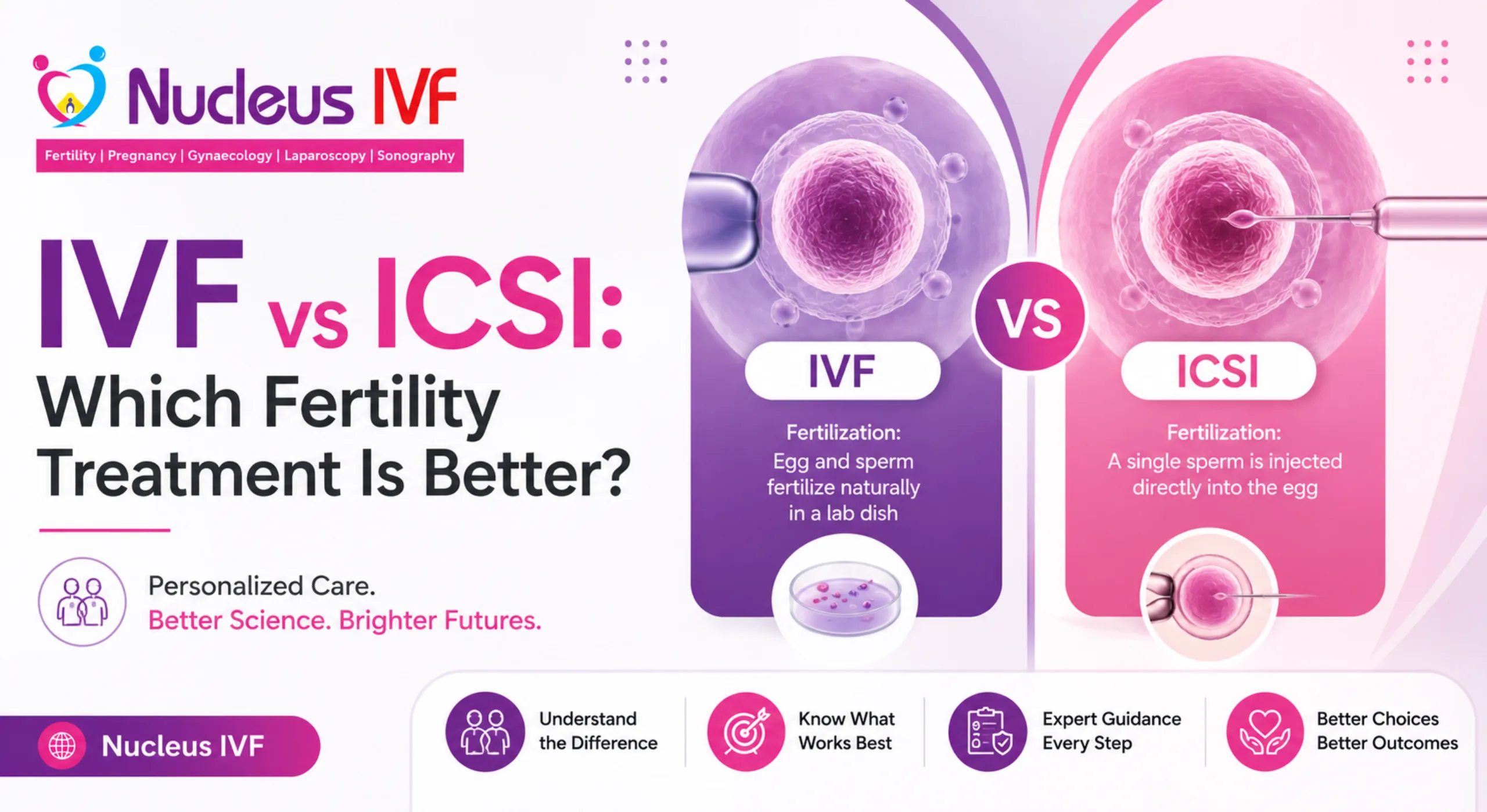
What Is IVF?
IVF (In Vitro Fertilization) is a fertility treatment where eggs are retrieved from the woman’s ovaries and placed together with thousands of sperm in a laboratory dish. The sperm naturally fertilize the egg on their own. The resulting embryo is then transferred into the uterus.
IVF works best when:
- The woman has blocked or damaged fallopian tubes
- There is unexplained infertility
- The couple has failed multiple IUI cycles
- PCOS is the primary cause of infertility
What Is ICSI?
ICSI (Intracytoplasmic Sperm Injection) is an advanced version of IVF. Instead of placing sperm near the egg and letting nature take its course, an embryologist injects a single sperm directly into the egg using a very fine needle.
ICSI works best when:
- The male partner has low sperm count (oligospermia)
- Sperm motility or morphology is poor
- There is azoospermia (no sperm in semen — sperm retrieved surgically)
- Previous IVF cycles had poor or failed fertilization
IVF vs ICSI — Key Differences at a Glance
| Factor | IVF | ICSI |
|---|---|---|
| Fertilization Method | Sperm + egg in a dish | Single sperm injected into egg |
| Best For | Female factor infertility | Male factor infertility |
| Sperm Count Needed | Normal to mild issues | Very low or zero |
| Success Rate | Good | Equal or slightly higher |
| Cost | Slightly lower | Slightly higher |
| Lab Complexity | Standard | More advanced |
So Which One Is Better?
Honestly, neither is universally “better” — the right treatment depends entirely on your diagnosis.
Think of it this way: IVF is like placing the sperm and egg in the same room and letting them meet naturally. ICSI is like introducing them directly — hand in hand. If the sperm are healthy and plentiful, IVF works beautifully. If the sperm need a little extra help, ICSI dramatically improves the chances of successful fertilization.
At Nucleus IVF Wakad, Dr. Pritam Prakash Sulakhe carefully reviews every couple’s diagnostic reports — including semen analysis, AMH levels, antral follicle count, and uterine health — before recommending IVF or ICSI. In many cases, ICSI is now the preferred approach as it offers greater control over fertilization and leaves less to chance.
So Which One Is Better?
Honestly, neither is universally “better” — the right treatment depends entirely on your diagnosis.
Think of it this way: IVF is like placing the sperm and egg in the same room and letting them meet naturally. ICSI is like introducing them directly — hand in hand. If the sperm are healthy and plentiful, IVF works beautifully. If the sperm need a little extra help, ICSI dramatically improves the chances of successful fertilization.
At Nucleus IVF Wakad, Dr. Pritam Prakash Sulakhe carefully reviews every couple’s diagnostic reports — including semen analysis, AMH levels, antral follicle count, and uterine health — before recommending IVF or ICSI. In many cases, ICSI is now the preferred approach as it offers greater control over fertilization and leaves less to chance.
Can Both IVF and ICSI Be Used Together?
Yes! In some cases, our team at Nucleus IVF may recommend performing both IVF and ICSI on different eggs retrieved in the same cycle — particularly when sperm quality is borderline. This combined approach maximizes the chances of getting healthy, viable embryos.
When Should You See a Fertility Specialist?
If you have been trying to conceive for over 12 months (or 6 months if you are above 35), it is time to consult a fertility specialist. Early evaluation can identify issues quickly and prevent unnecessary delays in treatment.
Dr. Pritam Prakash Sulakhe

Dr. Pritam Prakash Sulakhe
author
Dr. Pritam Prakash Sulakhe has completed his MBBS from B J Government Medical College , Pune which is one of the top medical College in India. He continued his post-graduation as DGO at same institute. After that he opted for Diplomat Of national Board In Obstetrics and Gynecology from Kerala Institute Of Medical Sciences Trivandrum, which is one of the most prestigious institute from South India.
